Here is an image that captures the human dilemma. “May the Lord help us,” and She always does.
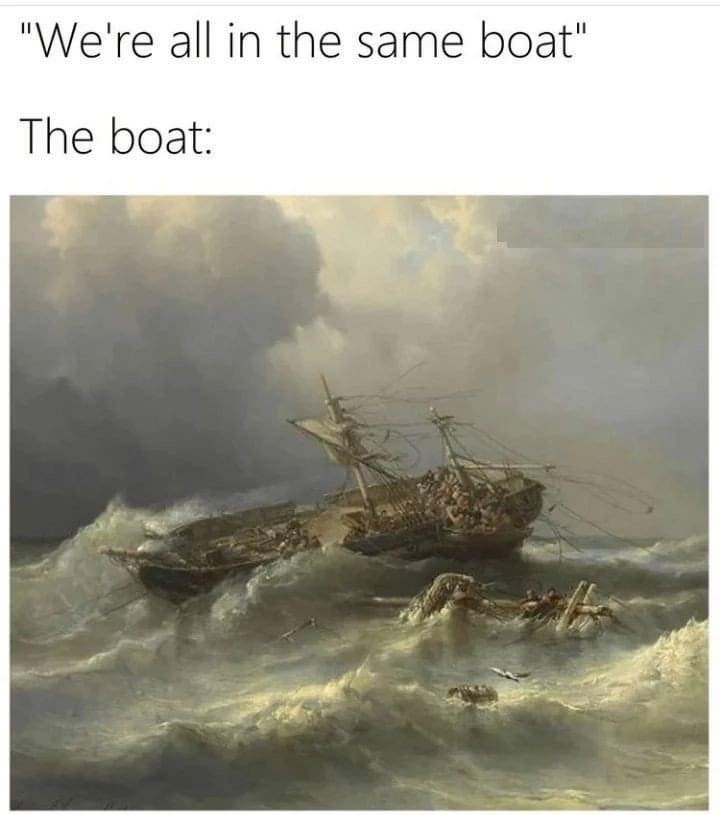

Here is an image that captures the human dilemma. “May the Lord help us,” and She always does.
Wisdom comes from a “literary” grasp of our life and world. It means having a relationship with the metaphor. The word metaphor means “to reach across” or venture from a concrete-thinking world into our adjoining world of meaning. Taking this step across means to loosen one’s moorings, to follow the wisdom of poet Stefan George, “To journey to a far world, it is necessary to lose sight of the shore.” Joan Didion who just died this week offered really profound wisdom in the quip I will now share with you:
We are imperfect mortal beings, aware of that mortality even as we push it away, failed by our very complication, so wired that when we mourn our losses we also mourn, for better or for worse, ourselves. As we were. As we are no longer. As we will one day not be at all….I think we are well-advised to keep on nodding terms with the people we used to be, whether we find them attractive company or not. Otherwise they turn up unannounced and surprise us, come hammering on the mind’s door at 4 a.m. of a bad night and demand to know who deserted them, who betrayed them, who is going to make amends. We forget all too soon the things we thought we could never forget. We forget the loves and the betrayals alike, forget what we whispered and what we screamed, forget who we were.
Stanley Kunitz, a former poet laureate of the United States put it this way, “We have walked through many lives, some of them my own. I am not the one I was, though some remnant of being remains from which I struggle not to stray.” Following is a link to this poem, “The Layers”:
Eureka Springs, Arkansas is one of my favorite spots on the map of our world. I lived for twenty years only a stone’s throw from this lovely Victorian Era village and visited it often. Here is a post from Facebook by a man who offered a prophetic for our world in 2013, Paul DeFatta:
Transfusions: (based on a disturbing dream that I had in Eureka Springs, Arkansas on 11/27/2013) Everything of genuine value, it would seem, must be earned and not stolen. Stolen goods come back to wreak vengeance upon their stealers. When precious gifts and persons come to us, stolen or unearned, we usually do not know how to properly receive them or even how to open them. To earn something—a lofty or profound insight, the heart of a rare and exceptional lover, a magnificent artistic creation—is to STRETCH to (or into) that gift, idea, heart, work of art, etc. Where there is no stretching and no earning, a human life begins slowly to wither, to ossify, to dry up, or to decompose. In short, there are countless ways to end our lives long before we actually die. Dying, withering souls that never bothered to learn how to stretch and to earn often become psychic parasites that feed off the morsels and crumbs they can filch from those around them—those whose hearts beat with even a slightly stronger pulse than their own does. When the psychic parasites in a society begin to significantly outnumber the dwindling number of vital “earners” and “stretchers,” things really begin to go downhill at a galloping pace. It becomes increasingly dangerous for healthy persons to venture out into the streets, where, as likely as not, they will be greeted by a blood-sucking, prattling army of the walking dead. They will suck the life out them with empty blather, each word of which hits the skin like a syringe or a gibbering little vampire bat. With every syllable, the host’s life blood trickles through a network of invisible tubes into tiny mouths that have gathered in the surrounding shadows. (from Facebook page, “Carl Jung and the Creative Bridge)
Another one of my “girlfriends” has shaken me out of my literary doldrum! One of them, Emily Dickinson, often does this but this morning a contemporary girlfriend, Julia Kristeva, has intervened. Kristeva is a Bulgarian-born linguist and psychoanalyst, educated in France and now practicing in Paris. Upon awakening, for some reason I plucked from my bedside bookshelf, “Black Sun: Depression and Melancholia” and opened it to a bookmark from earlier readings and found the following observation:
Once solitude has been named, we are less alone if words succeed in infiltrating the spasm of tears—provided they can find an addressee for an overflow of sorrow that had up to then shied away from words.
Or as George Eliot put it in the 19th century, “Speak words which give shape to our anguish…”
Oh, the power of language! I now realize that in my early youth when I discovered language I had found my home, a sacred domain which provided an haven from the morass of poverty and incest of my culture. And in my clinical training and practice I often witnessed the power of words being discovered by my clients…often with my facilitation…allowing them to “name the demons” that were haunting them. Leonardo Da Vinci realized this power of language in 15th century Italy, telling us:
O cities of the sea, I behold in you your citizens, women as well as men tightly bound with stout bonds around their arms and legs by folk who will not understand your language; and you will only be able to give vent to your griefs and sense of loss of liberty by making tearful complaints, and sighs, and lamentations one to another; for those who bind you will not understand your language nor will you understand them. Leonardo da Vinci, from “Of Children in Swaddling Clothes”.
Shakespeare thought there was and added that, “rough hew it though we may” the result will be the same. In the following Wendell Berry poem, the energy of this “destiny” is described as an “hunger organized” by the simple sparrow. The wisdom of these two wordsmiths tells us that we are lived by energy that we can never fully understand but even in the “rough hewing” that we do, there is purpose. This encourages me as I embark on another day of “rough hewing”!!!
A sparrow is
his hunger organized.
Filled, he flies.
before he knows he’s going to.
And he dies by the
same movement, filled
with himself, he goes
By the eye-quick
reflex of his flesh,
out of sight,
leaving his perfect
absence without a thought.
I chat via phone with a very gifted writer from New York City who lived here in Taos, New Mexico until about two years ago. This “confab” that we have bi-weekly is one of the most spiritually invigorating experiences I have in my life. She is writing an essay now on eidetic memory which brought to my tangentially-oriented mind the word “palimpsest.” And this, in turn, brought that same “tangentially-oriented” mind to the poet who introduced me to that term decades ago when I discovered the poet, Conrad Aiken.
A biographical note is in order. Aiken was born to a 1889 to a respected Savannah, Georgia physician and eye surgeon and his wife, the daughter of a prominent Massachusetts Unitarian minister. When he was eleven years of age, one morning he heard two gun shots ring out in his home and discovered that his father had shot his mother and then himself.. You can imagine the terror that gripped him. I share this anecdote because of a note that W.H. Auden made in a poem about William Butler Yeats, “Mad Ireland hurt you into poetry.” For that murder-suicide to have happened, you can only imagine the madness the reigned in Conrad’s household and certainly “hurt” Conrad into poetry also.
Here I wish to share a bit of an Aiken poem, followed by a link to the entire poem. It begins with how we “walk through many lives” and carry a bit of each of them with us as we constellate an identity. With the resulting synthesis we “see but the small bright circle of our consciousness, beyond which lies the dark this powerful poem, Aiken explores the intricacies of identity, the art of subterfuge inherent in daily life, the sadness, the narcissism, the disappointment, and the courage we find to carry on before the taunting of despair:
And, as it is with this, so too with all things.
The pages of our lives are blurred palimpsest:
New lines are wreathed on old lines half-erased,
And those on older still; and so forever.
The old shines through the new, and colors it.
What’s new? What’s old? All things have double meanings,—
All things return. I write a line with passion
(Or touch a woman’s hand, or plumb a doctrine)
Only to find the same thing, done before,—
Only to know the same thing comes to-morrow. . . .
If this poem speaks to you in the least, I encourage you to follow the link provided as it is a deeply moving poem from the heart of a poet full of very intense emotion with consummate skill is conveying his heart’s sentiments.
A Pakistani woman, a poet, essayest, and native of Pashtun, Hibah Shabkez, responds quite frequently to my musings in this blog. And, I am so, so honored with these visits from this extraordinary young soul who is now studying in Paris. She is about a third of my age but blessed with a wisdom, including a keen grasp of language, that I’m only now beginning to tippy-toe into, I’ve been exploring her work on the internet, and now own a book of her poetry, “Alack, The Ashen Waves of the Sea: Selected Poetry,” which is available at Amazon.com for a very reasonable price. But I will share here the most stunning bit of wisdom that I’ve seen put into words in my decades of spelunking about in the metaphysics of language.
In her brief essay from the on-line journal, “Nighting Gale and Sparrow,” Hibah puts into words a linguistic complexity which has burdened me for decades. Of late, I’ve come to somewhat understand this complexity but, have never been able to put into words as eloquently as she has. She explains that language initially blinds us to the Truth even as it assures us, often, that we have it most assuredly. The threat of understanding this wisdom that she offers is something I could not have handled most of my life; but now, it is immensely freeing, reminding me that all of us are in the same existential dilemma; and it is this “dilemma” that unites us all…if we can humbly accept its “condition of complete simplicity, costing not less than everything.” (T.S. Eliot) It takes all the pressure off and gives new meaning to the old hymnological bromide, “Burdens are lifted at Calvary”; or to word it without the hint of religious savagery, “Chill out. Carry on. All is well. We’re in this together.”
ScareZone by Hibah Shabkhez
When you touch the edge of something hot—a frying-pan, a clothes-iron—you gasp and flinch away, before the knowledge, before the shock and the hurt and the searing of flesh. Locked in the thumping of your heart then, there is the secret triumph of assault successfully withstood, the inexpressible comfort of knowing it could not and cannot hurt you because you did and can again make it stop. But the drenching heat of liquid cannot be flung off, only sponged and coaxed away from the skin. And so they say doodh ka jala, chhaachh bhi phook phook kar peeta hai. (Urdu translation, “Once bitten, twice shy.”) It doesn’t take all men, you see, it takes only one; and just so, it takes only one vile lie to break a language’s heart.
When first you write a lie, a real lie and not simply a truth incognito, whether it be falsehood or treacherous half-truth, language recoils from you in pain, vowing never to trust you with words again. But if you must go on writing lies, for money or grundy-respect, seize the language and let it feel the sting and the trickling fear of the skin parting company with the flesh, over and over and over again, as you hold it unscreaming under the current. You must let body and mind and heart and soul be quite maimed then, until there is no difference left for any of them between truth and lie, between the coldness of lassi (urdu–”buttermilk”) and the heat of milk-tides rising from the saucepan. Thereafter you may plunder with impunity all of language and force it to house your lies. And if you will never again find words to tell a truth in, it will not matter, for you will have no truths left to tell.
We “see through a glass darkly”. That is the best we can ever do but we have a deep-seated and potentially evil dimension of our heart that wants to see with clarity and assuredness. This is simply “being human” and to become the best human possible is to recognize this truth and humbly accept that it applies to “me” also. Here I write from this position of great limitation and am always beset with self-doubt–”Is this necessary?” or “Why bother?” or “What’s the point?” or, “Ain’t you got something better to do?” It would be much easier if I had simply guzzled that kool-aid of my youth and thus have the comfort of knowing….so to speak…”Thus saiith the Lord” in all my blathering. I think this is called “existential insecurity” but if one actually “exists” here in this world, that is, actually “dwells” here as the finite creature that we are there must be some degree of insecurity.
But thinking gets in the way of any such humility. By virtue of this Divine gift we have been subjected to the temptation to take our cognitive apparatus and its product–thinking, too seriously. We have then glommed onto a body of thought with which we are intoxicated to the point that we are incapable of any humility, believing in our belief rather than the Ground upon which we and within which we are rooted. This takes faith and faith is risky, entailing much more than clinging to the product of that “cognitive apparatus.” The cognitive trap that I am addressing is a prison from which one can escape if he is willing to pay the price, and the price was summarized by T.S. Eliot as, “…a condition of simplicity, costing not less than everything.” This price tag for myself has been the simple understanding and experience of recognizing this “trap,” a recognition which begins to loosen the bars of our imprisonment.
My country is currently demonstrating this entrapment with Trumpism. Hordes of Republicans “believe in their belief” of Trump; the resulting enthrallment by a cognitive apparatus gone awry cannot end without tragedy.
Last evening I stepped out into the bitter cold to witness Saturn and Jupiter come close to each other as if they were going to lovingly embrace, if you can consider “embracing” while separated by millions of miles. I can use the word embracing as in “touching” here only with the realization that in reality I am viewing this moment in our cosmic history from a physical distance of millions of miles. Even those two planets, appearing to be in “conjunction” are separated by five plus million miles. It is our “perspective” that allows us to witness this incredible moment in our history, giving us the necessary separateness that allows us to bring delight, joy, wonder and appreciation to the table. Before our perspective took roots in our early childhood we did not have the “luxury” of distance as we were part and parcel of a “moment” that we were immersed in and not able to cognitively/spiritually understand it. At that moment there was no “object separateness”…. to employ a bit of clinical jargon. It is the Biblical “fall” that gave us this detachment without which there would be no human culture. Spiritual maturity can gradually come to us in our “four-score and ten” when we grasp the wisdom of this Great Round of which we are but a part, a visitation of “Grace.”
The abysmal distance left us with a hunger to “close it up,” to find the lost connection and return to the delightful “Garden of Eden.” We pine for the relief from the burden of life in which we are separate and distinct, where culture seduces us into believing its artifice can give us that “Grand Conjunction” where grace awaits us. Culture, certainly language, can guide us in that direction but only if we see…and feel…that words will never suffice; they are but “pointers” to the Ultimate. The Buddhists so profoundly teach us, “The finger pointing to the moon is not the moon.”
Here I want to share another Edgar Simmons poem which beautifully and profoundly captures the experience of distance:
THE MAGNETIC FIELD
Distance…which by definition
Indicates a separation from self
Is the healing poultice of metaphor,
Is the night-lighting of poetry.
As we allot to elements their weights
So to metaphor we need assign the
Weight of the ghost of distance.
Stars are stars to us
Because of distance: it is in the
Nothingness which clings us them
That we glory, tremble, and bow.
O what weight and glory lie abalance
In the stretch of vacant fields:
Metaphor: the hymn and hum of separation.
How do people change? I’ve always been curious about this issue for I knew very early in life that I needed to change. Here are two pithy observations about this question, one from-13th century Persion mystic,Rumi and the other from a mere two decades by American playwright, Tony Kushner.
The Worm’s Waking
There is a worm addicted to eating grape leaves.
Suddenly, he wakes up,
call it Grace, whatever,
something wakes him, and he is no longer a worm.
He is the entire vineyard, and the orchard too,
the fruit, the trunks,
a growing wisdom and joy
that does not need to devour.
Kushner’s play “Angels in America offers a scene in which the internal tension of change is vividly put into words, presented here as a gut-wrenching experience involving a Divine encounter. Fortunately, most of the time it is merely discomforting or stressful as people like myself do not have the brilliant, sensitive, artistic
temperament of people like Kushner. Here is a quotation from one memorable scene:
Harper: In your experience of the world. How do people change?
Mormon Mother: Well it has something to do with God so it’s not very nice.
God splits the skin with a jagged thumbnail from throat to belly and then plunges a huge filthy hand in, he grabs hold of your bloody tubes and they slip to evade his grasp but he squeezes hard, he insists, he pulls and pulls till all your innards are yanked out and the pain! We can’t even talk about that. And then he stuffs them back, dirty, tangled and torn. It’s up to you to do the stitching.
Harper: And then up you get. And walk around.
Mormon Mother: Just mangled guts pretending.
Harper: That’s how people change.
December 10, 2020 Conservation
The socio/cultural/political morass which weighs down on us at this moment is very unnerving, even frightening matter; this is because it is a cosmic identity crosis, at least for one teeny-weeny little culture on this “Third Rock From the Sun.” It is teaching us so much about the ego, individually and collectively.
The development of our ego is a monumental event in our life. It is intrinsic to our ability to negotiate what the infant will discover as “reality”, a crisis in which twin poles of our Divinity war with each other. When our ego begins to come into existence, to come online, it struggles within its nascent existence as it loathes discovering its finitude. Only moments earlier, this very core of our being is enconsed in the womb of “no-thingsness” and is on the verge of making the decision to “fall” into this world of existants or remained in the comfortable, Edenic womb.
winnicott’s break down
 literary lew