Category Archives: group psychology

“Making Nice,” Trump, and the Social Contract

Donald J. Trump is a little boy who needs to be loved.  Never having learned the rudimentary dimensions of making himself loveable, he discovered that he had wealth and privilege to manipulate and intimidate people into a pseudo love.  One of the earliest lessons about love takes place when we enter school and find ourselves on the playground where negotiation with others involves a subtly that a child has often not had to deal with before.  The rules of “being liked” are not explicit but depend on an emotional maturity to pick up on the nuances of social life.  I like to think of it as learning to “make nice,” to not say or do the first thing that comes to your mind when you feel slighted.  It involves a tacit agreement to put up with another’s irksome attitudes and behaviors…to some degree…in return for the tacit response of others putting up with yours. This is the nuts-and-bolts of what we call the social contract.

If someone comes along to the playground who will not abide by the terms of this social contract, he will soon be known as a bully.  If you are “ugly and your mom dresses you funny” he is the one who will point it out while others will not say a thing, unconsciously knowing that you will not point out their own flaws and short comings. This reminds me of Trump on the “playground” of the debate stage in 2016 when he was rude and obnoxious, breaking all rules of civility and decorum.  On any debate stage, the candidates usually have a great dislike of others on the stage but there is an unwritten rule to not attack each other personally. Trump stomped all over that rule and as Senator Lindsey Graham put it, “The rest of ran and hid in the corner.”  When faced with a bully, one has a natural response to try to escape.

There is a certain insincerity to, “making nice.”  It is not, “telling it like it is” which Trump avowed and which many of his supporters cited as a reason they liked him.  “He’ll tell the truth, unlike those lying, hypocritical politicians we are used to,” they said.  Yes, but Trump’s “truth telling” is closely akin to that of someone with Tourette’s Syndrome who, severely lacking impulse control, will “tell it like it is,” and announce to a woman he has just met, “My you have a nice set of tits.”  This Tourette’s Syndrome man is certainly saying what nearly all other men are thinking but most of us have a social filter and would not say something like that.  (And I apologize for the “locker-room talk.”  Seriously.)
Self-awareness and Bullying

In my last post, I shared thoughts about bullying and self-consciousness or “self” awareness.  A couple years ago when I was on Facebook an upper classman when I was in Jr. High at my small Arkansas high school shared his shame and regret about bullying a helpless, self-conscious, insecure lad in his class. This gentleman had been a star athlete himself, later to have a tryout with the Arkansas Razorbacks; he was handsome, intelligent, and headed to success in his life.  On Facebook he shared about his effort to reach out to this man he had bullied to apologize but had received no response.  This gentleman had found awareness and now sincerely rued his cruel behavior to this “nerdy” and perhaps handicapped classmate.

Self “awareness” is something we mature into, slowly becoming aware of the “presence” of other people in our world and becoming sensitive to their reality.  There are times, however, when this maturity never comes and, furthermore, there are times when people are ensconced in a social milieu where this “self” awareness is discouraged.  The best example I find of this occurred in the New Testament with the crucifixion of Jesus, as explained by Fr. Richard Rohr who interpreted the famous words of Jesus on the cross, “Father, forgive them for they know not what they do” as, “Father, forgive them for they are not aware (or conscious) of what they do.”

These men did not awaken that morning, convene down at Starbucks, and suddenly decide, “Hey, let’s be mean and nasty, violent and brutal, and put that guy to death who does not see this world as we do.”  They had many meetings at that coffee shop in planning their deed and came to the firm conclusion that they were going to do the right thing, the “lord’s will,” if you please. They were firm in their convictions and many of them I’m sure were morally upright men, probably in a respectable position down at the local church….or, “synagogue” in that day.  They were probably members of the school board, members of the Lions Club, active in what used to be called, “benevolent societies,” and faithfully they bought Girl Scout cookies each spring.  And I’m sure that there were young, unmarried men in the mix also, those who avowed that they didn’t, “smoke, drink, chew…or go with the girls they do.”  But it is possible for good men to do bad things when they are driven merely by ideology, steeped with preconceived ideas about their world and the deep-seated conviction that they objectively understand the world.  When men and women are addicted to their ideas, regardless of how “noble” those ideas may be, they lack “awareness” and are capable of great evil in what they deem as service to the good.  T.S. Eliot summarized this problem, “Oh the shame of motives late revealed, and the awareness of things ill done, and done to others harm, which once we took for exercise of virtue.”

Reality Tightens its Noose on Trump.

I kick the subject of mental illness around a lot in this venue due to my career as a clinician which has given me a perspective to “sniff out” madness pretty readily.  Oh, we are all “mad” to some degree but then there are times when one’s madness goes beyond the pale and then the Shakespearean question is relevant, “What’s mad but to be anything else but mad.”  There are times when the ordinary madness of day to day life approaches the pale and threatens to go beyond it and enter the realm of “nothing else but mad.”

Trump is demonstrating this.  Here and in my other blogs I have noted often of his need to isolate himself in a private world, to cut off any criticism from those who see the world differently than he does, best illustrated with his hatred of, “fake news.”  But now as his “fake news,” known by most of us as “reality,” continues to tighten its noose on him, he is taking even more desperate moves.  The news about the non-disclosure agreements with his advisers and now the “cleaning house” with his staff and cabinet reveal a heightened need to cut off feedback from the outside.  Like Hamlet, overwhelmed with the duress of everyday life, expressed a desire to, “flee to a nutshell and there be the king of infinite spaces,” revealing Shakespeare’s knowledge of the human need to occasionally want a complete escape, even that of lunacy.

Obama’s, “Clinging to Guns and Religion.”

In 2008 Barack Obama was overheard dismissively speaking of people who, “cling to their guns and religion” which immediately provided fodder for the base of the Republican Party who didn’t really understand what he was saying.  Sure, it was impolitic for him to say that where it might be misunderstood but it was a valid and important observation about the ideologically-oriented base of the Republican Party who “cling” to ideas rather than have a complicated and subtle interior life so that ideas are not taken to be the “thing in itself.”

Guns are fine.  The problem arises when the “clinging” function of the ego gets involved as an innocent device is given an inordinate investment of energy so that “guns plus the emotional energy” becomes another matter all together.  The “guns + emotional valence” takes on a life of its own, becoming a core identity issue to the point where it is no longer about “guns” but is about the individual’s grasp of who he is, of his definition of, “who I am.”  The more tenuous is the grasp of one’s, “who I am” the more desperate will he cling to some idea or group of ideas that he has invested in to keep him from being devoured by an existential anxiety that lies at the root of all cultures.  This abyss of meaningless will destroy one if his spirituality has not equipped him with the ego-integrity to address this spirit of negativity which is an intrinsic dimension of human experience and needs to be acknowledged, not denied.  This “ego integrity” is a spiritual capacity which allows confronting the hidden depths of one’s heart and integrating them into conscious experience and finding empowerment as a result.  Without this acknowledgement and integration, the energy that could be available for deliberate, focused, conscious attention outside of oneself will be turned inward to keep those “demons at bay.”  This is a “divided heart” or the “divided house” which Abraham Lincoln famously noted cannot stand.

But this hopelessness does not have to destroy one if he finds the courage to slowly, gradually, patiently, and humbly confront it and in so doing discover that he can find increasingly an indomitable core beneath this hopelessness…if he is willing to give up the contrivance that his ego has tricked him into relying upon, whatever that contrivance/s might be. The spiritual impoverishment of our culture is now egregiously before us.  Beneath the various contrivances it offers us, guns being but one of them, lurks the abyss of hopelessness which can be addressed if we are willing to acknowledge our “willful ignorance”, an ego driven self-deception who has convinced us that a life of illusion is preferable to a life in which we live as a fully functioning, integrated human being.

***************************

Here is a list of my blogs.  I invite you to check out the other two sometime.

https://anerrantbaptistpreacher.wordpress.com/

https://literarylew.wordpress.com/

https://theonlytruthinpolitics.wordpress.com/

Imprisoned With Ideas!!!

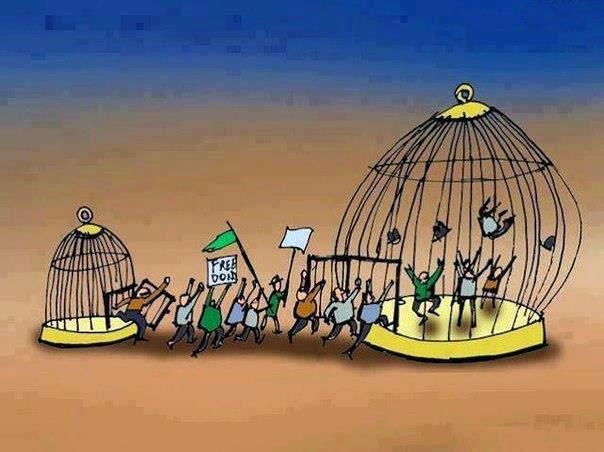
Jungian cage cartoon

“Woo-hoo, we’re Jungians!!!”

This cartoon beautifully illustrates the fate of ideologies which captivate lost souls who thus become “ideologues.”  Posted in a Carl Jung facebook discussion group, it demonstrates the necessary role of irony in dealing with ideas and avoiding their imprisonment, including the caption, “Woo-hoo, we’re Jungians.”  This cartoon reflected knowledge of a lesser known but profound quote from Carl Jung himself, “Thank God I’m not a Jungian!”  Jung knew that his teachings were captivating to some who did not exercise what the New Testament calls as, “discerning Spirit” and used his teachings to create a shallow ideological identity in which they could hide and avoid the gut-level wisdom that his teachings offered.

I facetiously toy with writing my copy of the Gospels someday, clearly identified as, “fictional,” and in them I would toss in at some point Jesus saying as he fled the hordes of “mindless” escape-oriented seekers, “Thank God I’m not a Christian.”  For Jesus’ teachings clearly recognized the entrapment of taking spiritual tradition and teachings only on the superficial level and he used the world, “hypocrites” to describe them, people who were simply actors offering to their community merely the “performance art” of spirituality.

This phenomenon which is so egregiously conspicuous now in my country takes the teachings of Jesus only as “ideas” without ever bothering to explore them in depth to the point of discovering that, “the idea is not the thing” and that ideas have value only when they open-up into a region beyond themselves.  The ability to understand this includes getting to the point where one realizes that buried in his heart is a hidden region that can be found only by opening oneself to it, an opening-up which is not a simple rational undertaking resulting from a moment of revivalistic fervor.  This “opening up” is the discovery of the mystery of life, buried far beneath the conscious edifice of one’s persona, related to what T.S. Eliot described as, “a condition of complete simplicity, costing not less than everything.”  Jesus put it this way, “You can find your life only by losing it.”  This is really difficult if you are a “cradle Christian,” one who has been enculturated into the Christian faith as it will often feel as if one is losing his faith.  In a sense, one will be losing his “faith” but possibly only its ideological dimension, allowing the freedom to venture into the, “substance of things hoped for, the evidence of things not seen.”


Trump as an Instrument of the Good???

The evangelical Christian support of Trump has been a sore point for me, given my background in fundamentalist Christianity and a continued emphasis in personal faith.  The evangelical trope, “The Lord has raised him up” to restore our country to greatness, (i.e. “Make America Great Again,”) has always been a really irksome bit of their rhetoric for me.  But, I now can certainly accept the notion of “the Lord’s” hand in “raising him up” as he has brought to the surface the full extent of our collective and personal shadow.  Here is a bit of wisdom from Francis Bacon (1561-1626) relevant to our collective unconsciousness’s intent in bringing this darkness to the light:

“We are much beholden to Machiavelli and others, that write what men do, and not what they ought to do . For it is not possible to join serpentine wisdom with the columbine innocency, except men know exactly all the conditions of the serpent; his baseness and going upon his belly, his volubility and lubricity, his envy and sting, and the rest; that is, all forms and natures of evil. For without this, virtue lieth open and unfenced. Nay, an honest man can do no good upon those that are wicked, to reclaim them, without the help of the knowledge of evil.”—Francis Bacon

This “knowledge of evil” is something we prefer to see in others, having a very human aversion to recognize that it lurks beneath the surface of us all.  This is particularly difficult for persons of faith to accept, especially the Christian faith, as being a “person of faith” often convinces one that he has “seen the light” perfectly and has clear judgment.  Trump has clearly shown all of us, even the whole world, just how impaired our judgment is; yes, even in the area of religion. W. H. Auden, in his narrative poem, “New Years Letter,” presents the, “Prince of Lies” as being a god-send as in spite of its evil intent, and often being necessary to, “push us into grace.” Trump is one of these opportunities for us if we could ever manage to pause that linear-thinking monstrosity of our collective Western thought and let it dawn upon us, in the words of Pogo, “Uh oh, we have met the enemy and he is us!” We could then be “pushed into Grace,” kicking and screaming every inch of the way.

********************

Here is a list of my blogs.  I invite you to check out the other two sometime.

https://anerrantbaptistpreacher.wordpress.com/

https://literarylew.wordpress.com/

https://theonlytruthinpolitics.wordpress.com/

Gaining the Whole World and Losing Your Own Soul

Yesterday’s post addressed the subject of alienation, being trapped in an inauthentic existence while the heart pines for the taste of genuine human experience.  This “imprisonment” is the situation in which one’s persona grips an individual so tightly that the heart has been stifled to the point that he has no awareness of any dimension of life other than the “suit of clothes” that he wears.  It is relevant to a poetic quip of W. H. Auden, “We drive through life in the closed cab of occupation,” seeing the world only through the skewed prism of our “occupation” or basic, unquestioned assumptions about life.

Auden had another observation about this existential predicament, noting in one poem, “In the desert of my heart, let the healing fountain start.  In the prison of my days, teach this free man how to praise.”  Auden recognized that this existential “entrapment” in the world of appearances often grates against the soul to the point that one wants an escape which, in his estimation, merits a simple prayer of gratitude for the gift of life.  We are “here” and this “here-ness” is the simplest but most profound thing that we have, the simple gift of “be-ing” alive in this brief parenthesis of time.

Social critics, writers, and artists have been crying out since the mid-19th century about this loss of soul which is the by-product of modern industrialized, technologized human life.  One of my favorite examples is Arthur Miller’s play, “Death of a Salesman” which was a smash-hit in 1949 and is estimated by many to be the greatest American play of the 20th century.  The lead character in the play, Willy Loman, is at the end of his successful career as a salesman and he is gradually feeling that his employer is “putting him out to pasture.”  In fact, this process culminates in the play when, after protestations to his boss about the matter, Willy is fired.

Miller uses Willy Loman and his family to poignantly illustrate the mid-20th century expression of what happens when a man comes to the end of his career and finds that he has nothing but emptiness remaining, his persona having become obsolete, or “used up” and cast aside by the corporate world.  Anger, resentment, and frustration overcome Loman as he realizes that his life is, “over,” over in that he no longer had an identity without the successes he delighted in with his job.  Without his persona, there was nothing left.

A social structure functions because of the human ability to take on a role, a “persona,” and fulfill the obligations of that role.  The problem arises only when that social structure becomes such a behemoth that individuals are devoured by it, their very lives having become only that of a “thing” which has as its primary purpose only in keeping the behemoth afloat.  The illusions of the culture become so powerful and stifling that there is no room left in an individual’s heart for authenticity.  In our modern consumer society this is often described as human identity having devolved to the point in which it’s only a “consumer,” a “consuming unit” designed to buy more “stuff,” and thus keep the “stuff-producing” apparatus going.  In this, “Brave New World,” of Aldous Huxley, human value can be summed up in the quip, “Whoever has the most toys at the end of the game is the winner!”

“Logical Lunacy” Besets All of US (illustrated by cartoon)


Image may contain: 8 people, people smiling, text


W. H. Auden bemoaned having to put up with the folly of, “a logical lunatic.”  In this cartoon is illustrated a dimension of a rational mind that is meticulously “rational” as long as you are confined to the premise, “I support Trump.”  If you do not support Trump, you will “see through this” and understand the implicit “logical lunacy” of the reasoning process demonstrated.  HOWEVER, this same “splinter in the brain” besets us all and leads to the “lunacy” we witnessed last night when the U.S. Senate could not pass a bill which led to our government shutting down.  There is a tendency with us all to believe only what we want and refuse to consider there is another way of looking at the world.  It is only when both sides of a disagreement can trot out some degree of “meta-cognition” and recognize this that compromise can be found.  When this cannot happen, the opposing sides “hunker down” and draw swords, emphatically declaring, “I’m right!  You’re wrong.—it is always easier to see the “logical lunacy” of the “other guys.”

AN IMPORTANT AFTER THOUGHT–It is so much easier to see the “logical lunacy” of the other guys!

e e cummings and individuation

The poet, e e cummings declared, “To be nobody but yourself in a world which is doing its best, night and day, to make you everybody else – means to fight the hardest battle which any human being can fight; and never stop fighting.”
The world has a primary task, socio-culturally speaking, of homogenizing the “raw-material” of the human “matter” that comes its way as we daily “rattle the world for our babies.”  And yes, our babies are the precious coins that our piggy-banks always have stored up for us though we so often don’t treat them with the respect they are due.  But as our babies begin the task of becoming humanized they find the homogeneity pressure is overwhelming and so often they meekly succumb to the pressure and become mere automatons, following the dictates of the tribe into which they are born.

e e cummings demonstrated in his poetry…and I’m sure in the whole of his life…his determination to “rebel against the machine” and thus we witness the absence of punctuation, capitalization, and often the absence of simple linear thinking.  And I’m made to think of “Bartleby the Scrivener”, the fictional creation of Herman Melville in the 19th century, whose compulsive, “I would prefer not to,” was his standard response to the structured workplace of the burgeoning industrial revolution of his day.

Human life is the daily conflict between the twin poles of a demand to comply with “fitting in” and the equally important need to “individuate.”  A healthy society will call for both but so often an imbalance is seen in which the “fitting in” is so heavily emphasized that little or no room is left for individuation and the tribe is left with a nation of sheep. When that happens, the wisdom of Proverbs 29 is relevant, “Where there is no vision, the people perish” for vision is not possible when group-think (or group “vision”) tyrannizes.

Shakespeare, Madness, and Trumpism

Sometimes I’m tempted to focus on Shakespeare alone in this blog.  His work offers us more wisdom than I’ve found anywhere else, if one has the courage and discipline to explore it.  As I’ve argued recently, I think his work reveals that he thought that madness inflicted the whole of this human endeavor and that even the “consensually validated reality,” if closely examined reveals this to be true.  Freud probably had this in mind with his book entitled, “The Psychopathology of Everyday Life

One line from the play, “Hamlet” that has always intrigued me on this subject is, “What’s mad but to be nothing else but mad?”  Shakespeare was telling us, “We are all ‘mad’ but the label ‘madness’ belongs only to those who are ‘nothing else but mad.’”  Yes, everyday life is “psycho-pathological” but to waste much time and energy calling it that is kind of, well, kind of “nuts.”  Labels like “psycho-pathological” or “mad” must be reserved for those who go beyond the pale of everyday insanity and illustrates for us what is really going on with our daily grind of “consensually validated reality.”

But there is a continuum to this madness that we are all inflicted with by virtue of being “mere” humans.  There are occasionally people, even prominent people, who come along and illustrate for us madness though manage to avoid institutionalization and possibly even become powerful political leaders.  In my lifetime I can think of people like Idi Amin,  Sadam Hussein, and their predecessors, Hitler and Mussolini. And, you guessed it, there’s Donald Trump.  Though Donald Trump was “freely” elected in a democracy, his election proves the speciousness of any notion of “free will.”   Trump is a good example of someone who Shakespeare would describe as mad but he would also note that with him there is definitely “something other” than mad, meaning he really doesn’t deserve the label “mad,” but he sure comes close to it!  He is pretty far down on the spectrum toward madness but he lives in a culture that has found what he offers valuable enough that they are willing to overlook words and deeds that would disqualify most people from the White House and from the entitlement of the word “sane.”

It would be so helpful if my country would use this moment in its history for self-reflection and consider the wisdom that Shakespeare offers us here.  If we were mentally healthy as a culture we could contemplate our “madness” as Shakespeare challenged us to do and not be daunted by the task, realizing that to contemplate the notion does not make us “mad.”  For, most of us in this exploration would learn to chuckle, or even guffaw at things we began to discover about ourselves, quirks and oddities which reveal merely the conflicted nature of human experience and do not mean that we are mad.  But one dimension of the human ego which can tyrannize one into madness is the fear of having any flaw, and of having any flaw coming to the light of the day.  That fear often drives us not acknowledge our conflicts even if this lack of acknowledgement causes these conflicts to worsen to the point of mental illness or even to the point of validating one who is mentally ill and electing him President of the United States.

******************************

Two other blogs of mine are listed here which I invited you to check out:

https://anerrantbaptistpreacher.wordpress.com/

https://literarylew.wordpress.com/

https://theonlytruthinpolitics.wordpress.com/