Michel Foucault and “Difference” in Contemporary America

Difference matters to me.  I was raised in a conservative, American South culture with religion being the paramount dimension in my particular subculture.  But this upbringing in a rigid, highly structured atmosphere of “us vs. them” troubled me and in my early adulthood I began to acquire a more inclusive, less linear-thinking oriented approach to life.  Now, in the latter stages of my life, the issue of sameness vs. difference is a paramount concern of mine, especially given the political climate in my country and in the world.

Today I stumbled across a book in my library, “The Order of Things” by Michel Foucoult, heavily marked up from my “youthful” enthusiasm of decades past.  In the quote which I will share, Foucoult explores the relationship between “sympathy” (i.e. sameness”) vs. “antinomy” (difference) and the dialogic imperative of an interaction between these two complementary dimensions of the human soul.

Sympathy is an instance of the same so strong and so insistent that it will not rest content to be merely one of the forms of likeness; it has the dangerous power of assimilating, of rendering things identical to one another, of mingling them, of causing their individuality to disappear—and thus rendering them foreign to what they were before.  Sympathy transforms.  It alters, but in the direction of identity, so that if its power were not counter-balanced it would reduce the world to a point, to a homogeneous mass, to the featureless form of the same:  all its parts would hold together and communicate with one another without a break, with no distance between them, like those metal chains held suspended by sympathy to the attraction of a single magnet.

But then Foucault presents “antipathy” as the opposite life-force, equally necessary, which seeks to counter the otherwise stultifying power of the demand for sameness.  What he calls “antipathy” is merely a drive for difference, an innate desire to not be swallowed by the whole of sameness, a “whole” which would be merely a “black hole” without consideration of this “antipathy” or difference.  Foucault declares:

Sympathy is compensated by its twin, antipathy.  Antipathy maintains the isolation of things (i.e. the difference, the desire and demand for independence) and prevents their assimilation; it encloses every species within its impenetrable difference and its propensity to continue to being what it is.

This notion of continuing “to being what it is” is an essential dimension of identity, an ability to “hang onto” a core of what/who one is even when beset by the challenges of difference.  With maturity, i.e. “ego integrity,” one can hang onto a core of who one is even as he negotiates with difference, (i.e. “antipathy”) and knowing that he can survive…and even thrive…with the benefit of “difference” (i.e. something new) into its mindset.

Poet Stanley Kunitz offered wisdom re this inner-core, this essence of who we are:

The Layers
BY STANLEY KUNITZ
I have walked through many lives,
some of them my own,
and I am not who I was,
though some principle of being
abides, from which I struggle
not to stray.
 

The “Terrible Two’s” Cry for Help–Somebody Stop Me!!!

The “terrible two’s” are the bane of many parents.  Toddlers at that age are beginning to learn the power of “no” and can frustrate mommy and daddy to no end!  But, parents intuitively know that with patient setting of limits and reinforcement for “good” behavior this internal conflict will be resolved, and the child will go on to learn the value of handling his internal conflicts and rages, dealing with them appropriately while learning to function in a social setting where other people’s wishes and needs receive consideration.

In my clinical practice, I did face circumstances where parents did not know how to set these limits and/or had a child whose neurological wiring was not amenable to learning these boundaries.  But there were occasions where parents made no effort to set limits to their two-year old, and in fact began to reward him for his outrageous behavior in the hope that he could be “bought off.”  By the time one kid in-particular reached mid-teens and was referred to me for counseling, he had learned that outrageous behavior and defiance of rules was the best way to get attention and had become the cornerstone of his identity.  In the case of one young man, he had to be placed in a residential treatment facility and not long thereafter found himself mired in the juvenile justice system.  Twenty years later, it would be amazing if I should learn that he has not been in prison for at least a stint.

This young lad had been taught that the best way to get validation (i.e. “love”) was to act out, to push limits to the point that he could not be ignored.  “Bad attention” was better than “no attention” at all and much better than accepting the mere crumbs of attention that fell from the table as a result of merely taking an ordinary role in the social structure of family and school.  A kid of this stripe makes me think of the Jim Carrey character in the movie, “The Mask” who announced with daring and bravado after still another display of craziness, leering at the camera with menacing face and grin, “Somebody stop meee!”

Donald J. Trump has been crying out from early childhood, “Somebody stop me.”  But sheer will power, augmented by tremendous wealth, taught him that he could roll over anybody that stood in his way, that, yes, even in the Presidential campaign he could announce, “I could stand in the streets of Manhattan and shoot somebody and my poll numbers would not go down.”  He is now a year and half into his term of office and his supporters are galvanized behind him, the Republican led Congress is giving him total allegiance, and evangelical Christians are standing firm behind him, avowing that God has chosen him for this occasion.  The checks-and-balances system that has been the backbone of our government has met its match, and those who could exercise these “checks-and-balances” are demonstrating abject cowardice before this mad man.

Trump is a delusional man and he has found millions of Americans and the Republican Party who are “drinking the kool-aid” and becoming intoxicated with the delusion.  Delusion is much easier than reality as the latter requires dealing with those “naughty people” who dare to look at things differently than we do.  It is much easier to pledge allegiance to a political Jim Jones and, metaphorically speaking, trek down to Jonestown, Guyana where barrels of that sweet nectar, “Certainty” will be waiting.

******************************************

Here is a list of my blogs.  I invite you to check out the other two sometime.

https://anerrantbaptistpreacher.wordpress.com/

https://literarylew.wordpress.com/

https://theonlytruthinpolitics.wordpress.com

Politics, Belief, and “a bit of wobbly”

Margaret Thatcher in 1990 brought the expression, “Don’t go wobbly” to the political table. At the time Saddam Hussein had invaded Iraq, Thatcher and George W. Bush were together in Aspen, Colorado discussing the ins and outs of a military response. As “W” appeared be equivocating, Thatcher told him, “This is not the time to go wobbly, George.” The opposite of, “wobbly,— going full speed ahead on a matter, throwing caution to the wind with utmost certainty–will always be appealing to many but the rigid certitude of such a stance often needs at least a tad of hesitation, a small dollop of what Shakespeare called, “the pauser reason.”

The relevance of this issue to our current political/cultural climate is obvious. And one dimension of this climate is the area of religion where “belief” is often held to so rigidly that many believers have found themselves “believing” themselves into a corner from which they can’t escape. This mind set avoids the wisdom of faith traditions that belief must be moderated with a bit of doubt here and there as when St Thomas prayed, “Lord, I believe. Help thou my unbelief,” or even Jesus when he prayed to his Father as the Crucifixion approached prayed, “Lord, if it be possible, let this cup pass from me.” Following here is a lovely poem which speaks of the need of a touch of “wobbly” in a person’s faith:

Belief by Lia Purpura

Light being
wavy and particulate
at once
is instructive—
why wouldn’t
other things or states
present as
both/and?
For instance
I both
believe and can’t.
Holding these
together produces
a wobble, I think
it’s time
to take seriously
as a stance.

Emily Dickinson and the Imprisonment of Specious Truth

The subject of truth continues to fascinate me with the term “fake news” becoming synonymous with any viewpoint that does not fit with ours.  Truth appears increasingly to be very relative with no real standard being applicable.  Oh sure, I’m a “relativist” myself but then I continue to believe in some basic standard of veracity which, should I breach it, I would evoke some sense of shame and an attempt to apologize.

But the wonderful 19th century American poet Emily Dickinson knew that it was possible for the human soul to select its constituent elements and fashion a private, “society” that would be, “proof and bulwark” (borrowing a term from Shakespeare) against truth.  She was a keen observer of the human situation in her day and noted how people tended to create a very private reality for themselves, congregate with like-minded souls, and then repel any contrary viewpoint.  Here is how she put it:

The Soul selects her own Society —
Then — shuts the Door —
To her divine Majority —
Present no more —

Unmoved — she notes the Chariots — pausing —
At her low Gate —
Unmoved — an Emperor be kneeling
Upon her Mat —

I’ve known her — from an ample nation —
Choose One —
Then — close the Valves of her attention —
Like Stone —

Note that Dickinson observed that after constructing this autistic shell of a world view, the individual would, “shut the door” and then assume a “Divine majority,” that is assuming a Divinity to which nothing could be “presented” any more.  She knew that at this point an individual had said, in the depths of his heart, “My mind is made up.  Don’t confuse me with facts.”

But often in this closed-minded world, Dickinson knew that Truth often visited and “kneeled at her low-gate,” bidding for admission.  But she had already pledged her troth to a particular viewpoint and “closed the valves of her attention like stone.”  The imagery of valves of attention, “closing like stone” is powerful, evoking an auditory image of the gates of attention clanging shut with finality.  When one has barricaded him/herself into a prison of specious certainty, and labeled it Truth, there is no way for those chariots that are always passing by to breach the force-field it faces.  The poison that results inside such a prison always makes me think of Westboro Baptist Church, David Koresh and his disciples, and Jim Jones and the Jonestown, South Africa disaster.

W. H. Auden offered relevant wisdom, “And Truth met him, and held out Her hand. And he clung in panic to his tall belief and shrank away like an ill-treated child.”

Faith and Truth, per Carl Sandburg


WHO AM I?
By: Carl Sandburg

MY head knocks against the stars.
My feet are on the hilltops.
My finger-tips are in the valleys and shores of 
universal life.
Down in the sounding foam of primal things I
reach my hands and play with pebbles of 
destiny.
I have been to hell and back many times.
I know all about heaven, for I have talked with God.
I dabble in the blood and guts of the terrible.
I know the passionate seizure of beauty

And the marvelous rebellion of man at all signs
reading “Keep Off.”
My name is Truth and I am the most elusive captive 
in the universe.

All of us have a body of thought rattling around our skull which constitute “truth” and is taken for granted.  This is a necessary, though in a sense specious, certainty that allows us to function in our consensually-validated reality.  But within the noisy “rattling around” in our skull, there are certainties and premises that need to be examined occasionally and Sandburg was telling us this is especially so with those posted with the sign, “Keep Off.”  Sandburg did not mean there are no “Keep Off” dimensions to our heart and mind but that we need to pay attention to this signage and occasionally entertain the notion, “Well, maybe I should look at that idea a little further?”  This is related to my often-cited favorite bumper sticker, “Don’t believe everything you think.”  One simple little example from my youth in central Arkansas was the certainty that blacks were inferior to whites.  There was no need to question it for it was a definite, and, “The Bible said it.”

I have watched so many truths fall by the wayside in my life time and have long since given up any faint belief that I own the truth, that at best there is some primordial Truth that lies beyond the grasp of our finite mind and that yes, in a sense that “Truth” even has us!  And if I ever start trying to explain that to you, flash the sign of the cross in my face and run away quickly as this is a matter that eludes the grasp of human cognition.  This “Truth” involves faith, but not of the escapist faith that is so common, but faith that there is a, “Divinity that doeth shape our ends, rough hew them how we may,” as Shakespeare told us.  And I personally think that those who are the most obnoxious about objectively knowing about that end…and usually the end for others…are doing the roughest hewing!

Reality Tightens its Noose on Trump.

I kick the subject of mental illness around a lot in this venue due to my career as a clinician which has given me a perspective to “sniff out” madness pretty readily.  Oh, we are all “mad” to some degree but then there are times when one’s madness goes beyond the pale and then the Shakespearean question is relevant, “What’s mad but to be anything else but mad.”  There are times when the ordinary madness of day to day life approaches the pale and threatens to go beyond it and enter the realm of “nothing else but mad.”

Trump is demonstrating this.  Here and in my other blogs I have noted often of his need to isolate himself in a private world, to cut off any criticism from those who see the world differently than he does, best illustrated with his hatred of, “fake news.”  But now as his “fake news,” known by most of us as “reality,” continues to tighten its noose on him, he is taking even more desperate moves.  The news about the non-disclosure agreements with his advisers and now the “cleaning house” with his staff and cabinet reveal a heightened need to cut off feedback from the outside.  Like Hamlet, overwhelmed with the duress of everyday life, expressed a desire to, “flee to a nutshell and there be the king of infinite spaces,” revealing Shakespeare’s knowledge of the human need to occasionally want a complete escape, even that of lunacy.

Clinging to Guns & Religion, “Part Deux”!!

Religion, like guns…as explored in my last post… is a contrivance but one that is a Divine intervention if we find the courage and humility to reach maturity and slough off the “letter of the law” dimension and wrestle with “the flesh,” the term the Apostle Paul used to describe the abysmal baggage of human-ness that we seek to avoid.   The word religion stems from, “re-ligio” which means “to bind together,” reflecting the human wisdom that we are a divided soul and need to be reunited with our self.  But this reuniting is painful as “the Fall” into human cognition, necessary for the creation of human culture, created us delightful…to a fault… personas that we are fearful of laying aside and allowing reunification with our inner Essence so that S/he can have expression.  We don’t realize that if we find the courage to go through the “crucifixion” necessary for this resurrection our persona will not be destroyed but merely integrated with our inner essence, giving the buried “Christ child” a chance to find expression in the form of a fully functioning authentic human being. But the “clinging to religion” that Obama recognized (see last post) gets in the way of the life process, individually and collectively.  And it is no accident that God—we find the perfect symbol for power and authority.  The ego has found a perfect expression to assert itself and with the slogan, MAGA, our country has found a mantra to energize a desire to return to past imperialistic glory.

“Clinging” in itself is central to the problem.  There is a popular bromide, “Love holds with an open hand.”  But in some circles, especially the conservative culture in which I was raised, “clinging” is an essential dimension of faith, illustrated in the classic hymn, “The Old Rugged Cross” with the line, “So we’ll cling to the old Rugged Cross….”  This is a stage of faith, very much related to a developmental stage in which we “cling” to our momma until maturity allows us to diminish the “clinging” and relax into a more open trusting with relationship with our Source.  This usually corresponds increasing trust in and with our very self, with others, and even life itself as we relax into the “loving embrace” of the One who “shaped us from our mothers womb.  Reminds me of the Old Testament wisdom, “Even the darkness is not dark to You, And the night is as bright as the day. Darkness and light are alike to You. For You formed my inward parts; You wove me in my mother’s womb. I will give thanks to You, for I am fearfully and wonderfully made; Wonderful are Your works, And my soul knows it very well.…”

Obama’s, “Clinging to Guns and Religion.”

In 2008 Barack Obama was overheard dismissively speaking of people who, “cling to their guns and religion” which immediately provided fodder for the base of the Republican Party who didn’t really understand what he was saying.  Sure, it was impolitic for him to say that where it might be misunderstood but it was a valid and important observation about the ideologically-oriented base of the Republican Party who “cling” to ideas rather than have a complicated and subtle interior life so that ideas are not taken to be the “thing in itself.”

Guns are fine.  The problem arises when the “clinging” function of the ego gets involved as an innocent device is given an inordinate investment of energy so that “guns plus the emotional energy” becomes another matter all together.  The “guns + emotional valence” takes on a life of its own, becoming a core identity issue to the point where it is no longer about “guns” but is about the individual’s grasp of who he is, of his definition of, “who I am.”  The more tenuous is the grasp of one’s, “who I am” the more desperate will he cling to some idea or group of ideas that he has invested in to keep him from being devoured by an existential anxiety that lies at the root of all cultures.  This abyss of meaningless will destroy one if his spirituality has not equipped him with the ego-integrity to address this spirit of negativity which is an intrinsic dimension of human experience and needs to be acknowledged, not denied.  This “ego integrity” is a spiritual capacity which allows confronting the hidden depths of one’s heart and integrating them into conscious experience and finding empowerment as a result.  Without this acknowledgement and integration, the energy that could be available for deliberate, focused, conscious attention outside of oneself will be turned inward to keep those “demons at bay.”  This is a “divided heart” or the “divided house” which Abraham Lincoln famously noted cannot stand.

But this hopelessness does not have to destroy one if he finds the courage to slowly, gradually, patiently, and humbly confront it and in so doing discover that he can find increasingly an indomitable core beneath this hopelessness…if he is willing to give up the contrivance that his ego has tricked him into relying upon, whatever that contrivance/s might be. The spiritual impoverishment of our culture is now egregiously before us.  Beneath the various contrivances it offers us, guns being but one of them, lurks the abyss of hopelessness which can be addressed if we are willing to acknowledge our “willful ignorance”, an ego driven self-deception who has convinced us that a life of illusion is preferable to a life in which we live as a fully functioning, integrated human being.

***************************

Here is a list of my blogs.  I invite you to check out the other two sometime.

https://anerrantbaptistpreacher.wordpress.com/

https://literarylew.wordpress.com/

https://theonlytruthinpolitics.wordpress.com/

Imprisoned With Ideas!!!

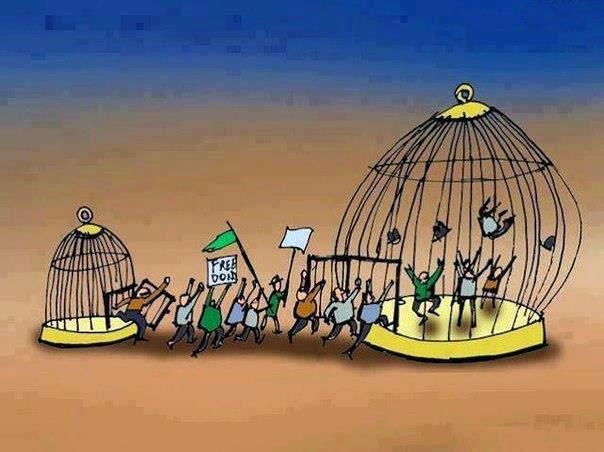
Jungian cage cartoon

“Woo-hoo, we’re Jungians!!!”

This cartoon beautifully illustrates the fate of ideologies which captivate lost souls who thus become “ideologues.”  Posted in a Carl Jung facebook discussion group, it demonstrates the necessary role of irony in dealing with ideas and avoiding their imprisonment, including the caption, “Woo-hoo, we’re Jungians.”  This cartoon reflected knowledge of a lesser known but profound quote from Carl Jung himself, “Thank God I’m not a Jungian!”  Jung knew that his teachings were captivating to some who did not exercise what the New Testament calls as, “discerning Spirit” and used his teachings to create a shallow ideological identity in which they could hide and avoid the gut-level wisdom that his teachings offered.

I facetiously toy with writing my copy of the Gospels someday, clearly identified as, “fictional,” and in them I would toss in at some point Jesus saying as he fled the hordes of “mindless” escape-oriented seekers, “Thank God I’m not a Christian.”  For Jesus’ teachings clearly recognized the entrapment of taking spiritual tradition and teachings only on the superficial level and he used the world, “hypocrites” to describe them, people who were simply actors offering to their community merely the “performance art” of spirituality.

This phenomenon which is so egregiously conspicuous now in my country takes the teachings of Jesus only as “ideas” without ever bothering to explore them in depth to the point of discovering that, “the idea is not the thing” and that ideas have value only when they open-up into a region beyond themselves.  The ability to understand this includes getting to the point where one realizes that buried in his heart is a hidden region that can be found only by opening oneself to it, an opening-up which is not a simple rational undertaking resulting from a moment of revivalistic fervor.  This “opening up” is the discovery of the mystery of life, buried far beneath the conscious edifice of one’s persona, related to what T.S. Eliot described as, “a condition of complete simplicity, costing not less than everything.”  Jesus put it this way, “You can find your life only by losing it.”  This is really difficult if you are a “cradle Christian,” one who has been enculturated into the Christian faith as it will often feel as if one is losing his faith.  In a sense, one will be losing his “faith” but possibly only its ideological dimension, allowing the freedom to venture into the, “substance of things hoped for, the evidence of things not seen.”


A Texas “Outlaw” Poet Demonstrates Semiotics

In the six years that “literarylew” has existed, I’ve explored poetry at great depth.  A lot of my exploration has been in the area of semiotics, that unconscious domain where instincts and external demands of society encounter each other and an identity amenable to symbolic participation in the world is created.  If this identity is too well-endowed with instinctual energy, psychosis could emerge in the extreme.  If “external demands” rule the day, then at an extreme linear thinking will prevail one will find comfort in the world that W. H. Auden described as that of, “a logical lunatic.”  The goal is for both dimensions of human experience to freely interact with instinctual energy finding expression in socially acceptable terms.

But the poet has that “id”-stinctual energy working with more intensity than those of us who live a more prosaic life.  With the poet, words cavort about in the subterranean regions of the heart, making it challenging to, “buckle his distempered “swollen” heart within the belt of rule….as Shakespeare put it.  The energy of instinctual energy that would threaten dissolution is harnessed by the poet’s capacity to use words to bind that energy and to use words creatively. At the conclusion I will include a poem by Archibald MacLeish who so beautifully describes the meshing of what William James called the, “blooming, buzzing, confusing world of sense experience” with words.)

However, I first would like to introduce you to my most recent blog subscriber, a Texas “outlaw” poet, Jeff Callaway, whose life story and poetry so beautifully illustrates the struggle of one poet in “binding” the energy of his heart and life.  This poem is a hodgepodge of imagery, often lacking “sense” other than to one who has a heart for poetry and will intuit and feel a whole lot of “sense” by giving it a close, attentive reading.  Here I quote the initial stanza of this raucous and often bawdy poem which clearly reveals this man’s energy bursting at the seams:

the greatest poems
are never written down
but lonely and forgotten
before a pen can be found
the greatest poems never find the ink
in the time it takes you to think
slowly with time they fade
and face the guillotine
of jilted poems and unrequited lovers
or glued to my own vague memory
of what could’ve been
if only i’d had a pen
and the recollection to keep repeating
what it was i was trying to say…

For the whole of this poem, check out this link:  https://texasoutlawpoet.com/2018/02/16/the-greatest-poems-of-all-by-jeff-callaway-texas-outlaw-poet-2/

“Words in Time,” by Archibald MacLeisch:

Bewildered with the broken tongue
of wakened angels in our sleep
then lost the music that was sung
and lost the light time cannot keep!

There is a moment when we lie
Bewildered, wakened out of sleep,
when light and sound and all reply:
that moment time must tame and keep.

That moment like a flight of birds
flung from the branches where they sleep,
the poet with a beat of words
flings into time for time to keep.

**********************

Here is a list of my blogs.  I invite you to check out the other two sometime.

https://anerrantbaptistpreacher.wordpress.com/

https://literarylew.wordpress.com/

https://theonlytruthinpolitics.wordpress.com/