Interesting church sign
Leave a reply

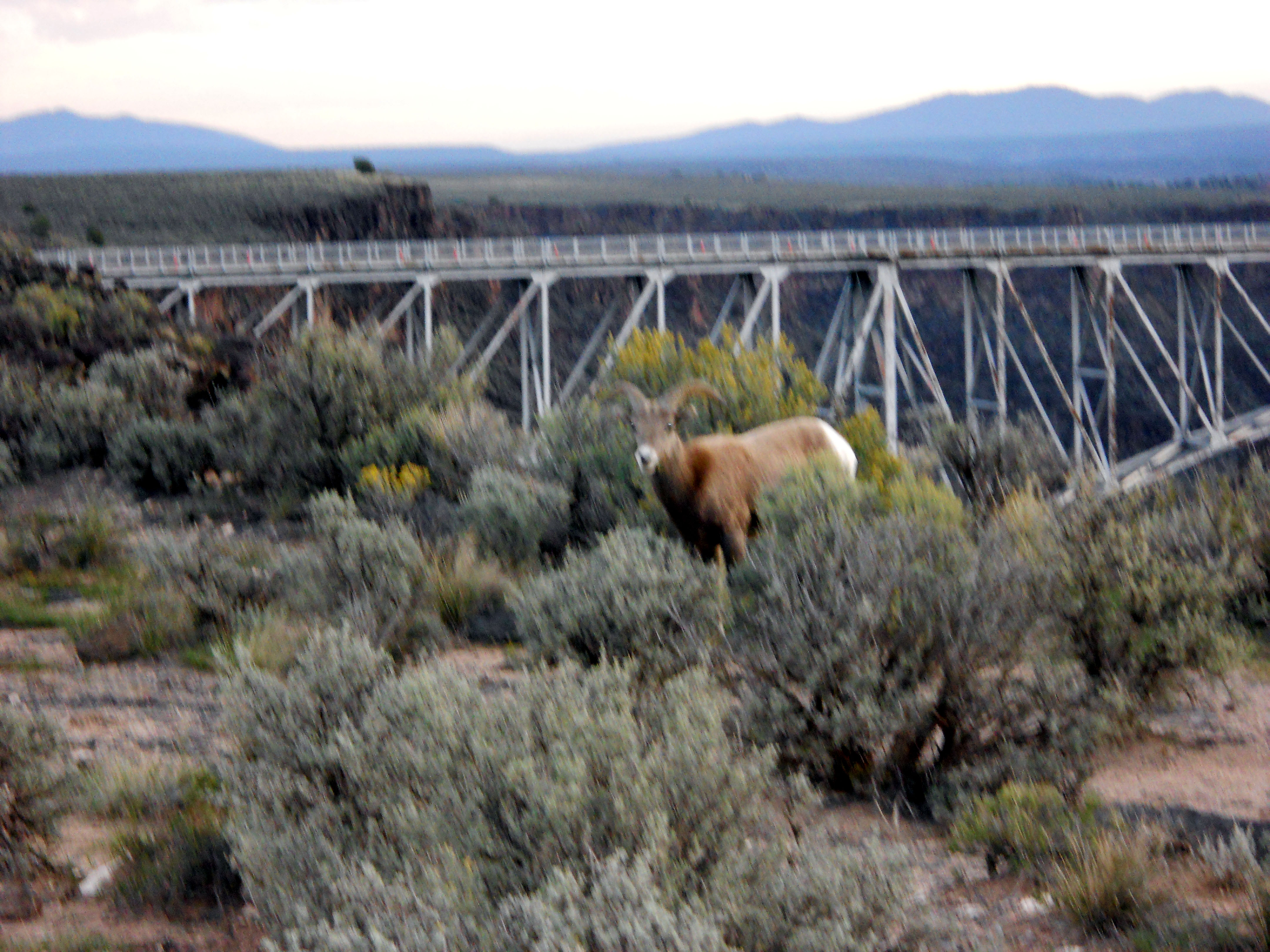
Actually, I think it is called a "big" horn sheep. Does anyone know the difference between "bighorn sheep" and "longhorn sheep"???? Regardless, twas a lovely sight.
 Be patient. I’m trying to learn how to use photos here. Hint—pay close attention. Some people do not see the dog “contenting” himself. This photo was shot in Arroyo Seco, NM., just outside of Taos.
Maturity involves acknowledging the shadow side of our life, embracing it even, and learning to live with it all the while disallowing it from predominating in our life. It is there. We can deny it, even put our blinders on, but it is still there! Even those who live an Ozzie and Harriet life still have a shadow side.
And relevant to this shadow side, I’d like to share today’s posting from Richard Rohr:
Expelling what you can’t embrace gives you an identity, but it’s a negative identity. It’s not life energy; it’s death energy. Formulating what you are against gives you a very quick, clear, and clean sense of yourself. Thus, most people fall for it. People more easily define themselves by what they are against, by who they hate, by who else is wrong, instead of by what they believe in and whom they love.
I finally got around to procuring and starting to read a book that has been around a long time—If You Meet the Buddha On the Road, Kill Him: The Pilgrimage of Psychotherapy Patients. (Sheldon Kopp, 1972) This is a must-read for all psychotherapists and psychotherapy clients. It delves elegantly and eloquently into the essence of therapy and the intricate boundary complications between a therapist and his/her clients.
One of my favorite anecdotes from the book is his discussion of the Gilgamesh myth and an early example of the shadow. He describes how Gilgamesh was an oppressive tyrant who became so overbearing that his subjects consulted a goddess, Arura, and asked her to intervene. Arura, displaying feminine wisdom, knew that the answer was to create a double for Gilgamesh who would wrestle with him and teach him that he too was a mere mortal.
And that is what our shadow does—reminds us that we from the dust of the earth like all people and creatures. We want to think that we are noble far beyond the herd but if we openly acknowledge our shadow when we look at “them”—those people who embody all the things we loathe—we have to humbly confess, “There go I but for the grace of God.” Or to quote a favorite bromide of mine, “What we see is what we are.”
Let me quote Kopp: Each of us has such a shadow from which he flees. Each man is haunted by that specter of a double who represents all that he would say “no” to in himself. To what extent I deny my hidden twin-self, you may expect to see my personality twisted into a grotesque mask of neurotic caricature.
And here are a couple more gems from Kopp, “All of the significant battles are waged within the self.” Or, as W. H. Auden put it, “We wage the war we are.” And then Kopp notes re a client of his, “He prefers the security of known misery to the misery of unfamiliar insecurity.” Shakespeare put it this way, in Hamlet, noting that we prefer to “cling to the ills that we have, than fly to others that we know not of.”
I have made several references to the books of Richard Rohr. Richard is a Franciscan monk who emphasizes meditative prayer and a contemplative faith. Though he is passionate in affirmation of his Catholic faith, he does not dismiss the grievous errors of the Catholic church and its tendency to be dogmatic and power-mongering. Of course, this can be said of any faith, of any ideology that has ever come along.
Two of his books in particular have really spoken to me. The Naked Now emphasizes a non-dualistic approach to the Christian tradition and to any other tradition that we might subscribe to. We are all trapped in the time/space continuum and we have a difficult time ever transcending that dimension, that abyss of a dualistic view of the world.
He also has a book of meditations out, which is just a compendium of wisdom from his various books, speeches, sermons, and audio recordings—Radical Grace: Daily Meditations by Richard Rohr.
Rohr emphasizes the need of escaping dogmatism. If our faith is going to be real, and therefore efficacious in our life and in our world, it has to be more than the mere regurgitation of dogma that we have been inculculated with.
Check out the following link to learn more about his daily affirmations that are available by email.
http://www.cacradicalgrace.org/richard-rohr/dailymeditations
And I close with the wisdom of Leonard Cohen: O bless this continual stutter of the Word being made flesh.

Someone said, "I'll take one of them there fried pies"
There is a well-known story of Jesus encountering a rich man who wanted to enter the kingdom of heaven. And Jesus told him to sell all his possessions and give them to the poor. (See Mark ch. 10). Now I don’t think Jesus was telling us that we need to sell all of our “stuff” and give to the poor. He merely recognized the attachment of that man to his riches and knew that it was an impediment to his spiritual welfare. I have known of people who have taken a vow of poverty and given everything away. I’m not inclined myself! I like my stuff. However, I am more conscientious about non-attachment to my “stuff” and have made an effort to be more generous in my day to day life.
I heard someone point out one time that anyone who is miserly with his money (and stuff) is also going to be miserly with his heart.
John Donne’s famous sonnet, Batter My Heart is a tale of one man’s battle to submit to God’s will. He writes eloquently of his own stubbornness, his innate opposition to being visited by God, even though God is the very thing that he wants most. He laments that his reason is held captive and that he finds himself “betrothed” to God’s enemy, Satan presumably. He presents this longed-for visitation from God as a violation. And it even has a sexual theme to it, “Except you enthrall me, never shall be free, nor chaste, except you ravish me”.
Batter my heart, three-person’d God, for you
As yet but knock, breathe, shine, and seek to mend;
That I may rise and stand, o’erthrow me, and bend
Your force to break, blow, burn, and make me new.
I, like an usurp’d town to’another due,
Labor to’admit you, but oh, to no end;
Reason, your viceroy in me, me should defend,
But is captiv’d, and proves weak or untrue.
Yet dearly’I love you, and would be lov’d fain,
But am betroth’d unto your enemy;
Divorce me,’untie or break that knot again,
Take me to you, imprison me, for I,
Except you’enthrall me, never shall be free,
Nor ever chaste, except you ravish me.
Earlier in the week I quoted from Tony Kushner’s Angels in America re the difficulty, the gut-wrenching pain which can accompany change. I would like to elucidate a bit further on this score. Kushner concludes this description of the intense pain of change with the observation, “And then up you get. And walk around. Just mangled guts pretending.” His point was that at some point in your suffering you must “get up” and “walk around” even if it involves a lot of pretending.
It is very important that we “walk around” but not in the sense of wandering around aimlessly. It is important that we act with purpose and meaning, that we act productively, even in the midst of our suffering. This can be as simple as getting up from bed and getting the kids off to school, or cleaning the dishes, or watering the plants, or visiting a friend. And you won’t necessarily “feel like” doing these things. But it is imperative…if at all possible…to muster up the energy to take action. This can be an effective antidote to the actual abyss of depression which is a debilitating inertia.
Shakespeare in Hamlet noted the importance of action. Hamlet declared, “Assume a virtue, if you have it not.” He then elucidates, though with Shakespearean wordiness, “That monster, custom, who all sense doth eat, of habits devil, is angel yet in this, that to the use of actions fair and good he likewise gives a frock or livery, that aptly is put on.”
And in Hamlet’s famous “to be or not to be” soliloquy he notes that great ambitions and plans are often “sicklied o’er with the pale cast of thought” and in the process “lose the name of action.”
 I really think they should consider re-naming this church.
